
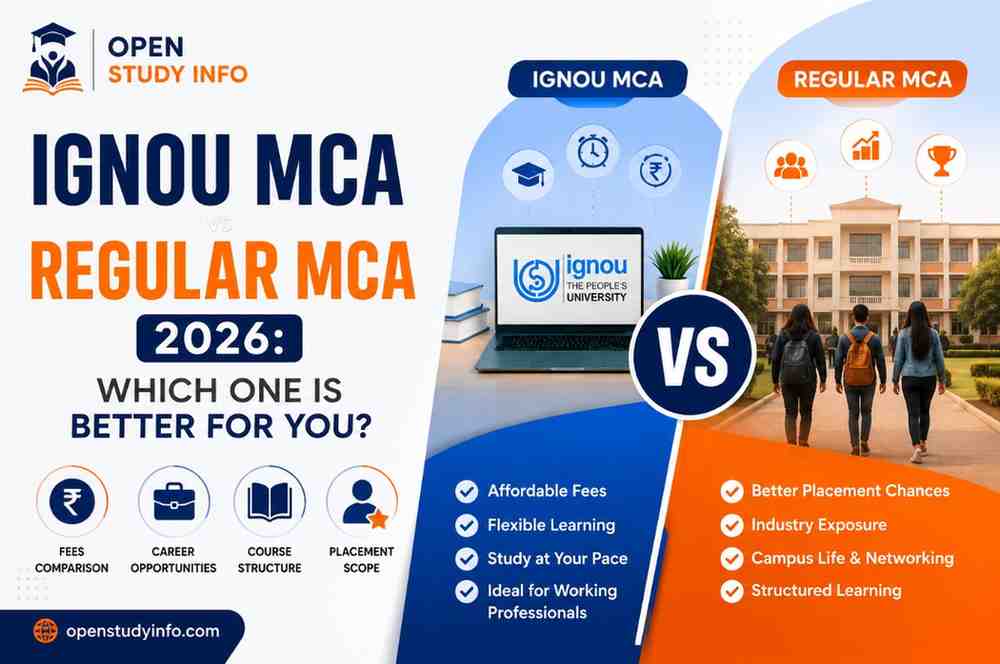
Most comparisons between IGNOU MCA and regular MCA either overgeneralize (“they’re the same, don’t worry!”) or try to talk you out of distance education altogether. The truth is a lot more specific than that, and it depends entirely on your current professional situation, what you want after graduation, and how much the fee difference actually matters to you. Here’s the real placement picture, the real gaps, and the situations where each option genuinely makes sense.
📌 Quick Comparison: IGNOU MCA vs Regular MCA
- Duration: 2 years for both (post-NEP revision)
- IGNOU MCA fee: ₹52,000 total (Category 1) | ₹54,000 (Category 2 with bridging courses)
- Regular MCA fee: ₹80,000 to ₹5,00,000+ depending on college tier
- Recognition: Both UGC recognised — IGNOU is additionally NAAC A++ and AICTE approved
- Placements: Regular MCA offers campus placements; IGNOU has no dedicated placement drive for MCA
- IGNOU is best for: Self-driven learners, working professionals, students on a tight budget
- Regular is best for: Graduates seeking campus recruitment, networking, and lab facilities
📋 Basic Info: What Each Programme Actually Looks Like
Before going into the comparison, here’s what you’re actually signing up for with each option.
IGNOU MCA runs for two years in Open and Distance Learning (ODL) mode, across four semesters. You study through printed and digital study material, submit an assignment each semester, and appear for a Term-End Examination (TEE) per course at your nearest IGNOU study centre. There are no compulsory classes. The programme is offered under IGNOU’s School of Computer and Information Sciences.
IGNOU Assignment Status Not Updated
Regular MCA is a two-year, on-campus postgraduate degree offered by various universities — NITs, central and state universities, and private colleges. Classes run daily, you’re expected to be present in computer labs, and projects are done under faculty guidance. You get to interact with peers on your projects. The infrastructure, education quality, and placement support vary a lot depending on the specific college.
✅ Eligibility: Who Can Apply for What
| Factor | IGNOU MCA | Regular MCA |
| Minimum Qualification | BCA / B.Sc CS / B.Sc IT (Category 1) — or any bachelor’s degree with Mathematics at 10+2 or graduation level (Category 2, with two bridging courses) | BCA / B.Sc CS / B.Sc IT or equivalent in most cases. Some colleges accept any graduate with a Maths background. Varies by institution. |
| Minimum Marks | 45% in the qualifying degree | Typically 50% to 60% at decent state or central universities |
| Entrance Exam | None — admission is merit-based | NIMCET for NITs; state-level entrance exams for state universities; many private colleges offer direct admission |
| Age / Work Experience | No age restriction — working professionals are encouraged to apply | Typically no age bar, but on-campus mode requires full-time attendance |
⚠️ Category 2 applicants at IGNOU: If your degree isn’t in Computer Science — say, a B.Com or BA with Maths — you’re still eligible, but you’ll need to complete two bridging courses (MCS-201 and MCS-208) in Semester 1 and pay an additional ₹2,000. That brings your total to ₹54,000 instead of ₹52,000. These bridging courses cover programming and data structures fundamentals, so they genuinely serve a purpose rather than being just an administrative formality.
💰 Fee Comparison: The Gap Is Real
IGNOU’s advantage here is undeniable — the total fee for its two-year MCA is ₹52,000. For Category 2 students, it’s ₹54,000. Regular MCA fees, on the other hand, vary a lot more:
- 🏛️ NIT MCA — roughly ₹80,000 to ₹1,20,000 per year, so around ₹1.6L to ₹2.4L for the full two-year programme. Heavily subsidised, but you need a NIMCET score to get in.
- 🏛️ State university MCA — ₹20,000 to ₹80,000 per year, depending on the state and university. Some are genuinely affordable.
- 🏢 Private college MCA — ₹80,000 to ₹2,50,000 per year. Total costs can cross ₹5 lakh at mid-tier private colleges, often without a proportionate placement outcome.
💡 Real talk on fee vs value: If you’re choosing between an IGNOU MCA and a good NIT or central university MCA, the extra cost at the NIT is generally justified — the placement network and campus experience make the higher fee worth it. But if you’re choosing between an IGNOU MCA and an average private college MCA, the calculation flips. Paying ₹3-4 lakh at a mid-tier private college that offers weak placements is not a better deal than IGNOU — it’s a worse one, for a degree that carries less weight.
🎓 Recognition: Government Jobs, Private Sector, and Higher Studies
IGNOU MCA is recognised by UGC, DEB, and AICTE. IGNOU itself holds a NAAC A++ accreditation and was ranked #1 among open universities in the NIRF 2024 rankings.
For government jobs — SSC, PSC, UPSC, PSU roles, banking, and teaching services — degrees from IGNOU are accepted, and lakhs of IGNOU graduates are currently employed across government departments in the country.
For private sector IT jobs, here’s what actually matters:
- 📊 Don’t expect BPOs, mid-sized IT firms, most service companies, or startups to filter candidates based on whether their MCA is from IGNOU or a traditional college. Your outcome comes down to your skills, your portfolio, and your interview performance.
- 🏢 IGNOU MCA graduates aren’t turned away by large IT services companies like TCS, Infosys, or Wipro — as long as they’ve completed the UGC-mandated coursework and perform well on the technical tests.
- ⚠️ Unfortunately, top-tier product companies do apply a strict college-tier filter at the résumé stage, and IGNOU graduates typically don’t clear that filter. To be fair, the same applies to graduates of most non-NIT regular MCA colleges too — this isn’t unique to IGNOU. These are the FAANG-adjacent roles where campus brand carries real weight.
📊 Placements: The Honest Picture
This is the part most blogs either oversell or gloss over — so here’s the actual situation.
Regular MCA placements vary a lot by college:
- 🏆 NIT MCA graduates generally see strong placements. Median packages in the ₹6-12 LPA range are common at the better NITs, with top offers crossing ₹20 LPA.
- 🏫 State university placements are a mixed bag and depend heavily on the specific college. Some top state colleges — in states like Karnataka, Tamil Nadu, and Maharashtra — have decent placement records. Average state colleges generally don’t.
- 🏢 Private MCA colleges show mixed results. A number of colleges inflate their placement numbers using walk-in drives rather than genuine campus placements. Verify the numbers independently before trusting a college’s claims.
Documents Required for IGNOU Admission 2026
The reality of IGNOU MCA placements: IGNOU does run placement drives through its headquarters — in 2026, one such drive offered over 200 job openings across edtech, aviation, hospitality, and other service sectors. But there’s no dedicated campus recruitment drive specifically for MCA students the way a residential NIT or college runs one, and IGNOU students don’t get on-campus interview access the way regular college students do.
According to IGNOU’s NIRF 2026 report, the university-wide average salary was between ₹2.45 LPA and ₹2.85 LPA — but this figure blends in shorter courses and undergraduate programmes too, so it isn’t a clean MCA-specific number.
⚠️ Set realistic expectations: Without a dedicated placement programme for MCA, most of your job hunting as an IGNOU MCA student will happen independently — applying directly and preparing for technical interviews on your own. This is very doable, especially in IT, where a strong GitHub profile or personal projects carry real weight. Just don’t go in expecting campus recruitment, because it isn’t there.
🧑💻 Learning Experience: What You Actually Get
With IGNOU MCA, you get:
- 📚 Study material, assignments, and TEE-based evaluation each semester
- ⏰ Full flexibility — no fixed class schedule, study at your own pace
- 🏠 No relocation needed — you can keep working and living where you are
- ❌ No labs, no in-person faculty access, no peer or group learning
- ❌ No college infrastructure like coding rooms, hackathons, or a placement cell
With a regular MCA, you get:
- 🧑🏫 Classroom learning with direct faculty access and doubt-clearing sessions
- 💻 Computer lab access and hands-on project work
- 👥 A peer cohort — study groups, team projects, and healthy competition
- 🏢 A placement cell, alumni network, and company tie-ups (varies a lot by college)
- ❌ No flexibility — attendance is mandatory, which doesn’t suit working professionals
🤔 Who Should Actually Choose IGNOU MCA?
IGNOU MCA is a genuinely good fit if you’re in one of these situations:
- 👔 You’re already working in IT or a related field and need a formal MCA degree — for a government job, a promotion, or an eligibility requirement — without quitting your job.
- 💰 Your budget is tight and the gap between ₹52,000 at IGNOU and ₹2-3 lakh at a private college is a real constraint, not a minor one.
- 🎯 You didn’t get into a good NIT or central university MCA, and what’s left are mid-tier private colleges with shaky placement records — IGNOU with self-driven skill building is a genuinely stronger alternative in that scenario.
- 🌍 Good regular MCA options in your area would require relocating, and relocation isn’t possible for you right now.
Read more:IGNOU Full Form: Meaning, History & Importance in 2026
Who Should Choose Regular MCA Instead?
A regular MCA — specifically at a good NIT, central university, or reputed state college — makes more sense if you:
- 🎓 Are a fresh BCA or B.Sc CS graduate with no work experience, since campus placements are far more accessible to fresh graduates than to someone applying independently.
- 🏆 Have a solid NIMCET score or state entrance rank and can get into a quality government college — the fee-to-placement ratio at top NITs is genuinely strong.
- 🤝 Value peer learning, faculty interaction, and the professional network that comes from studying alongside 60-80 people for two years.
- 💼 Are targeting IT companies that run on-campus hiring, where regular college students have structured access that IGNOU students simply don’t.
❓ Frequently Asked Questions
1. Is IGNOU MCA valid for government jobs in 2026?
Yes. IGNOU MCA is UGC and DEB recognised, and IGNOU holds AICTE recognition for technical programmes like MCA. It’s accepted for government IT jobs, PSU recruitment, SSC, state PSC exams, and other government roles that require a UGC-recognised degree.
2. Do private IT companies hire IGNOU MCA graduates?
Yes — most mid-sized IT companies, service companies, and startups don’t pay attention to mode of study. TCS, Infosys, Wipro, and similar companies hire IGNOU graduates through their open hiring process. There’s no campus recruitment from IGNOU though, so you’ll be applying on your own. Top product companies and some MNCs do filter by institution tier, and IGNOU won’t help you there — but that’s equally true for most non-NIT regular MCA colleges.
3. What is the total fee for IGNOU MCA in 2026?
The total programme fee is ₹52,000 for Category 1 students (BCA, B.Sc CS/IT background) — ₹13,000 per semester across four semesters. Category 2 students (non-CS background with Mathematics) pay ₹54,000 in total, including an extra ₹2,000 in Semester 1 for two bridging courses.
4. Does IGNOU MCA offer campus placements?
IGNOU runs placement drives through its Delhi headquarters, and some students do get placed through these. But there’s no dedicated campus recruitment programme for MCA students the way a residential NIT or college offers. If campus placement matters to you, a regular MCA from a good institute gives you far better access to it than IGNOU does.
5. Is an IGNOU MCA considered equivalent to a regular MCA degree?
Yes, in terms of legal recognition — both are UGC-recognised MCA degrees, valid for the same jobs and higher studies. What differs is the experience around the degree: networking, lab access, and placement support aren’t the same. The degree itself carries equal weight; the infrastructure around it doesn’t.
6. Should I choose IGNOU MCA or a private college MCA?
If the private college in question is mid-tier, has uncertain placement outcomes, and charges ₹2-4 lakh, IGNOU MCA with self-driven skill building is the more sensible choice. If the college has a strong track record, real industry connections, and the fee is justified by actual placement outcomes, the regular route makes more sense. What you shouldn’t do is pay significantly more for a college that doesn’t deliver a meaningful career advantage over what IGNOU already offers.
📌 Quick Reference: IGNOU MCA vs Regular MCA
- Duration: 2 years for both
- IGNOU MCA fee: ₹52,000 (Cat 1) | ₹54,000 (Cat 2)
- Regular MCA fee: ₹80,000–₹5,00,000+ depending on college
- Recognition: Both UGC recognised — IGNOU also AICTE and NAAC A++ accredited
- Placements: Campus placements only for regular mode — IGNOU is self-driven
- Choose IGNOU if: You’re working, budget-constrained, or weighing IGNOU against a weak private college
- Choose regular if: You have a seat at a good NIT/central/reputed state college with real campus placements
People Also Read:IGNOU Assignment Submission Last Date 2026
The right question isn’t whether IGNOU MCA is “good enough” in general — it’s whether it fits your specific situation. If you’re a working professional who needs a formal degree, or someone who’d otherwise end up paying three times the fees at a weak private college for a fraction of the value, IGNOU MCA is a genuinely sensible path. If you’ve earned a seat at a quality NIT or central university MCA, take it — the two aren’t really in competition; they serve different situations.