
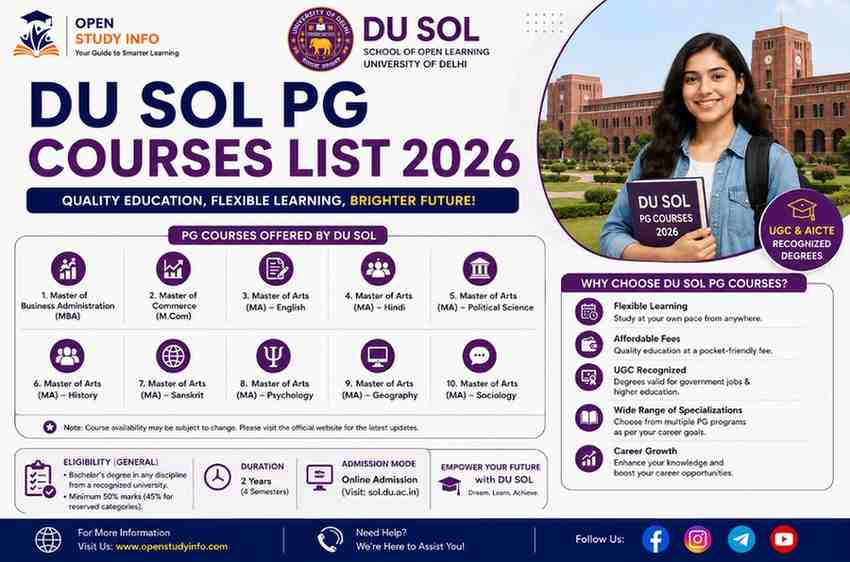
Delhi University’s School of Open Learning has developed a reputation in India for being one of the more convenient postgraduate options for working students. This has coincided with the largest shift in their PG offerings for the 2026 academic year. Aside from their traditional two-year Master’s programmes, SOL now offers a one-year postgraduate path for those who have completed the Four-Year Undergraduate Programme, giving FYUP graduates a significantly faster pathway to their postgraduate degree. This catalog outlines the DU SOL PG courses on offer for 2026, along with expected costs, eligibility criteria, and a breakdown of this year’s admissions process.
Quick Reference: DU SOL PG Courses 2026
- Core PG programmes: MA (numerous subjects), M.Com, MBA, MLISc, BLISc, and PGDADLM
- From the 2026-27 session: one-year Master’s degrees in Commerce, Political Science, History, Hindi, and Sanskrit, exclusive to Four-Year UG Programme (FYUP) graduates
- Admission to MA and M.Com is through CUET-PG, with DU graduates considered on merit if seats remain unfilled
- No entrance exam for MBA or MLISc; MBA admission runs on a composite merit score
- Application is submitted online at sol.du.ac.in, with a fee of ₹500 for General/OBC/EWS and ₹250 for SC/ST/PwD
Read More:DU SOL Transcripts Online for WES Canada/UK Evaulation
Complete DU SOL PG Courses Listing for 2026
Postgraduate offerings at DU SOL now span two categories: the established two-year programmes, and the newly introduced one-year track. The two-year and one-year programmes are outlined below.
| Programme | Duration | Streams/Specialisations |
| MA | 2 years | Hindi, History, Political Science, Economics, English, Sanskrit |
| M.Com | 2 years | Commerce (general) |
| MBA | 2 years | General management, distance mode |
| MLISc | 1 year | Library and Information Science |
| BLISc | 1 year | Library and Information Science (bridge programme for library professionals) |
| PGDADLM | 1 year | Advanced Digital Library Management (PG diploma) |
| New one-year Master’s (2026-27 onward) | 1 year | Commerce, Political Science, History, Hindi, Sanskrit — FYUP graduates only |
Enrolment in MA and M.Com is preferred by most students because of the wide range of subjects and lower fees, while MBA and the library science programmes are frequently chosen by working professionals who want a postgraduate qualification without interrupting their career.
New for 2026-27: One-Year PG Programmes for FYUP Graduates
This is the biggest announcement of the year. Starting from the 2026-27 academic session, the School of Open Learning will offer one-year Master’s programmes through the Open and Distance Learning mode for graduates of the Four-Year Undergraduate Programme. At this initial stage, one-year Master’s programmes in Commerce, Political Science, History, Hindi, and Sanskrit will be offered.
SOL Director Payal Mago has stated that these programmes will run alongside the already existing two-year PG programmes. There are no changes to the two-year postgraduate structure, and three-year undergraduate degree holders will still have to pursue the two-year pathway for a Master’s degree. The one-year programmes are only available to FYUP graduates, while the two-year programmes remain the route for all other graduates.
Since this announcement is fresh, registration is expected to open in the near future rather than being live already. The SOL portal is the best source of confirmation for FYUP graduates wanting to know when registration opens, since no fixed date is available for this new programme yet.
One-Year or Two-Year: Which Should FYUP Graduates Choose?
If you’re an FYUP graduate, you’re not automatically locked into the accelerated one-year track — the standard two-year MA or M.Com route is still open to you if it suits your situation better. The choice really comes down to what you need the degree for and how much time you can commit.
The one-year programme makes the most sense if you want to move into the job market or a professional certification quickly and don’t need the deeper, semester-by-semester coursework of the two-year format. Because it’s brand new, though, there’s limited track record yet on how employers or further-study committees will weigh a one-year SOL Master’s against the established two-year version — something worth factoring in if you’re planning to use the degree for a specific career step, like a promotion that requires a PG qualification, or eligibility for a competitive exam with its own recognition rules.
The two-year route, by contrast, is the well-established option with years of graduates behind it, familiar recognition across employers and further academic programmes, and the same subject depth SOL has offered for a long time. If you’re not in a hurry and want the safer, better-understood credential, sticking with the two-year MA or M.Com is a reasonable call even if you technically qualify for the one-year track.
DU SOL PG Admission 2026 Eligibility Requirements
Across most two-year PG programmes, the general eligibility is a bachelor’s degree with 50% marks from a UGC-recognised university, with a 5% relaxation for SC, ST, OBC, and other reserved categories. Several PG programmes carry additional requirements, as detailed below:
- MA and M.Com: Bachelor’s degree with 50% marks (45% for reserved categories); a valid CUET-PG score is generally needed for admission
- MBA: Any bachelor’s degree. Unlike other programmes, admission is based on a composite merit score (graduation marks plus work experience) and no entrance exam is required
- BLISc and MLISc: Relevant degree, preferably in library science; for BLISc, work experience in the library sector is considered
- PGDADLM: Graduate degree, generally aimed at library professionals wishing to add a digital library management qualification
- New one-year Master’s: Must have completed the Four-Year Undergraduate Programme and meet the specific eligibility and regulatory requirements SOL has set for this track
Final-year students aren’t barred from applying either — applications for MA, M.Com, and MBA are accepted provisionally, with enrolment confirmed once the final marksheet shows the required percentage.
DU SOL PG Admission Process: CUET-PG vs Merit
Programme-specific admission logic is where most applicants get confused:
For MA and M.Com, admission to DU SOL is based on CUET-PG scores. Any seats remaining after the CUET-PG round are filled through a merit list based on graduation marks, a route that mainly benefits DU graduates. Non-DU graduates should plan on taking CUET-PG to secure a seat.
MBA admission does not consider CAT, MAT, or any other entrance exam. Admission is based on a composite merit score combining graduation marks and professional work experience. Reports vary on how work experience is weighted and whether it’s mandatory, so confirm the official notification for the current year rather than relying on past criteria.
For MLISc, admission in most cycles is also based on merit from the qualifying degree.
💡 Pro Tip
If you’re a DU graduate planning for MA or M.Com and thinking about skipping CUET-PG, don’t assume the merit list will definitely be available. The merit list only opens up if seats remain vacant after the CUET-PG round. Taking CUET-PG anyway is the safer plan and keeps your admission chances from depending on how many seats happen to remain.
DU SOL PG Course Fees 2026
As in past years, DU SOL PG courses remain among the more budget-friendly options in Delhi, though the exact cost varies depending on the course and your category. This year, the PG course fee range has been reported at roughly ₹2,800 to ₹45,000 annually depending on the course, with some courses carrying a total fee of about ₹60,000-₹62,000 for the entire duration. MBA fees are reported starting from around ₹20,000 and are typically quoted separately from the other PG course fees.
Because reported costs vary and fees can change with each admission cycle, always check the specific figure on the official website before budgeting for your course. The application fee is more consistent: ₹500 for General, OBC, and EWS category applicants, and ₹250 for SC, ST, and PwD applicants.
⚠️ Common Mistake to Avoid
Don’t rely on the admission cost from a random blog or forum post. Fee structures for DU SOL PG courses are revised with every admission cycle, and sourced figures differ greatly between sites. Before paying, check the most current fee structure for your course and category on sol.du.ac.in.
DU SOL MBA Admission: Unique Features
The MBA programme’s admission process differs from MA and M.Com and deserves a separate mention. There is no CUET-PG requirement and no separate management entrance exam — admission is purely merit-based, built on a composite score of graduation marks and professional work experience. This makes the programme accessible both to fresh graduates with strong academic scores and to professionals with several years of relevant experience who have no interest in taking the CAT or MAT.
Reports have been inconsistent across different admission cycles and sources regarding how work experience is weighted, and whether a minimum number of years is required. If work experience is a key part of your application, the safest approach is to check the current year’s MBA admission notification rather than relying on last year’s criteria.
Crucial Details for DU SOL PG Admission 2026
Reported dates for the 2026-27 PG admission window are inconsistent, with the portal opening reported anywhere from early June to mid-June 2026, and the deadline without a late fee reported anywhere from end-June to end-August 2026. Some reports indicate a late-fee window extending into September 2026 for programmes including MBA, MLISc, and PGDADLM. Given these discrepancies, don’t rely on any single reported date to plan your admission — check the official site sol.du.ac.in for confirmed dates to avoid missing a window.
People also read:DU SOL Degree Valid for Government Jobs?
Required Documents for DU SOL PG Admission
- Bachelor’s degree certificate and mark sheets for each semester or year
- Category certificate (SC/ST/OBC/PwBD), if applicable
- Recent passport-size photograph with a plain background
- CUET-PG scorecard, where relevant to your programme
- Proof of work experience for MBA aspirants who want to include it for merit
- Government-issued photo ID
Completing the online application takes about 20-30 minutes on sol.du.ac.in once your documents are ready.
Frequently Asked Questions
Which PG courses does DU SOL offer in 2026?
Core courses include the 2-year MA and M.Com, the 2-year MBA, and the 1-year MLISc, BLISc, and PGDADLM. Starting in the 2026-27 session, SOL has also added one-year Master’s programmes in Commerce, Political Science, History, Hindi, and Sanskrit, exclusively for FYUP graduates.
Is the new one-year PG programme open to all, or only FYUP graduates?
The programme is only for graduates of the Four-Year Undergraduate Programme. If you hold a traditional three-year undergraduate degree, you’ll go through the regular two-year MA or M.Com route instead.
Is CUET-PG mandatory for entry into DU SOL’s MA or M.Com programmes?
For most applicants, yes. DU graduates may gain entry through a merit-based fallback if CUET-PG admissions leave vacant seats, but for non-DU graduates, taking CUET-PG is essentially a must.
Are CAT and MAT mandatory for DU SOL MBA?
No. DU SOL MBA admission runs on a composite merit score combining graduation marks and professional work experience, with no separate management entrance exam required.
What’s the eligibility for DU SOL PG courses?
Most DU SOL PG courses require a bachelor’s degree with at least 50% marks (45% for reserved categories) from a UGC-recognised university. MLISc, BLISc, and PGDADLM carry their own subject-specific conditions tied to library and information science.
Can final-year students apply for DU SOL PG courses?
Yes. Final-year undergraduate students can apply provisionally for MA, M.Com, and MBA, with admission granted once the final marksheet shows the required percentage.
Read also:Documents Required for DU SOL Admission 2026
Conclusion
DU SOL’s core offerings have stayed stable for years — MA, M.Com, MBA, and the library and information science programmes. What’s new is the one-year Master’s programme for FYUP graduates; if you fall into that cohort, it’s genuinely worth a look. As with all programmes, the costs and deadlines in this guide are approximate — check sol.du.ac.in for current details before you apply. For more DU SOL guides on admissions, eligibility, and courses, keep checking back on openstudyinfo.com.