
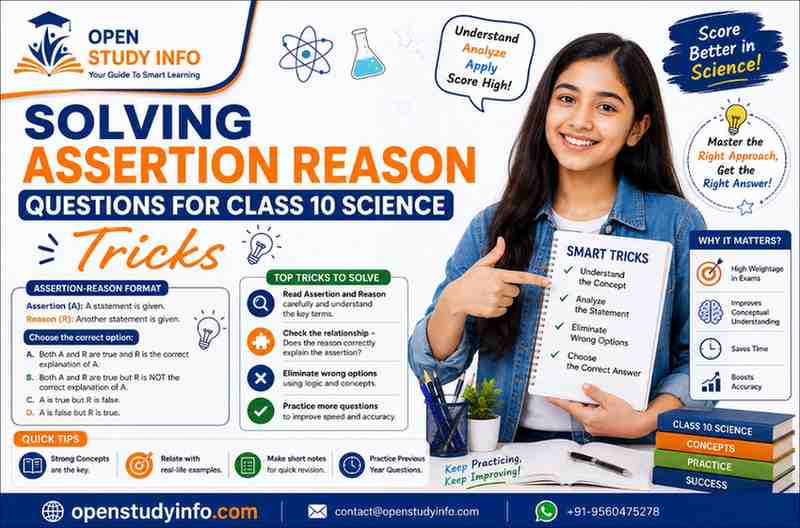
Of all the questions in the Class 10 Science exam, Assertion Reason questions are the ones that most confuse students. The main reason for this is not that the concepts are difficult, but that the questions utilize a structure that many students are not familiar with. Because of this, many students find this the most difficult part of the exam, and it is the most frequently asked question at Open StudyInfo. Our aim is to make this easier by outlining a clear and easy step-by-step method for these types of questions.
At the end of this guide, you will have a clear understanding of the Assertion Reason question structure and the logical trick that will give you the answer in seconds, as well as the most common traps set by CBSE.
Note: If you only memorize answers and do not understand the actual concept, you will have a difficult time answering Assertion Reason questions. Since these types of questions require a little more thought, they are much easier to answer with logic rather than trying to guess the answer.
Read also:Documents Required for DU SOL Admission 2026
What Is Assertion Reason?
Each Assertion Reason question contains 2 statements.
- Assertion (A) — A statement that is a declared fact.
- Reason (R) — A statement that is said to provide explanation for the Assertion.
It’s not enough to just determine whether each statement is factually correct. You need to see whether the Reason is actually addressing the Assertion, or if they are unrelated and the Reason is just a true statement. This is the main source of mistakes and lost marks, since most students just check whether the Reason is true or false, but completely skip the step in which they determine if R explains A.
The Four (or Five) Standard Answer Options
The questions in Class 10 Science involving Assertion and Reason have a nearly uniform set of answer options.
| Option | Meaning |
| (a) | Both A and R are true, and R correctly explains A |
| (b) | Both A and R are true, but R does NOT correctly explain A |
| (c) | A is true, but R is false |
| (d) | A is false, but R is true |
| (e), if given | Both A and R are false |
Simply memorize this answer key. The time wasted when you have to read and interpret the options in the exam is time that can be saved by simply memorizing the key.
How to Quickly Solve Assertion Reason Questions
Now look at the Assertion and judge the Reason alone. This time, don’t think about the Reason as a whole, but as a collection of statements you need to determine the scientific validity of.
Only now, compare the two. If both are true, ask the key question: does the Reason directly and correctly explain why the Assertion is true? If yes, you’re looking at option (a). If both are true but the Reason is addressing something unrelated, or gives an explanation that doesn’t logically connect, choose option (b).
If only one statement is true, you don’t need to compare them at all — just match it directly to option (c) or (d) depending on which one is true.
Tip: Evaluate the Assertion and Reason completely independently before comparing them. Judging them in unison, or reading them together, could lead to the untrue Reason “feeling” correct because it sounds related — this is the exact trap that the CBSE question-setters rely on.
Worked Example
Assertion (A): Copper wires are commonly used for electrical wiring in homes.
Reason (R): Copper is a good conductor of electricity and is also durable and cost-effective compared to many other conductors.
Is the Assertion true? Yes. Is the Reason true? Yes. Does the Reason provide a correct explanation for the Assertion? Yes, it does. The correct answer in this scenario is (a).
The Reason presented as “Copper is the only metal that conducts electricity” would actually be an incorrect statement (other metals such as Silver, Aluminum, and Gold, also conduct electricity). This would result in the answer automatically being option (c) — A is true, but R is false.
A Second Example Where Option (b) Is a Trap
Assertion (A): Diamond is a very hard substance.
Reason (R): Diamonds are very good conductors of electricity.
Let’s apply the same three-step process here. Is the assertion (A) true? Yes. Considering the fact that Diamond is one of the hardest known natural substances, this statement is true, and we can assume that this is true. Is the Reason (R) true on its own? No. Considering that Diamond does not actually conduct electricity, this reason is false. Since the Reason is false on its own, this logical explanation is not necessary. Therefore, Option (c) must be the correct answer. This means A is true and R is false.
Now assume the Reason said, “Diamond has a giant covalent structure with strong bonding between atoms.” In this case, both statements would be true. Would this Reason explain electrical conductivity, or would it explain the hardness of the Assertion? In this instance, it would explain why diamonds are hard. The bonded structure is what makes diamond hard. Therefore, this version is option (a). This is the type of minor change that differentiates option (a) from (b), and is the essence of “compare only after analyzing separately.”
Why CBSE Incorporates This Type of Question
Assertion Reason questions became common after CBSE went through a phase of restructuring with an emphasis on competency-based learning. This involves less emphasis on rote learning and a greater emphasis on whether students can apply and connect the concepts of what they have learned. A student who learns through memorization of definitions, without an understanding of the underlying “why,” will often answer these questions incorrectly, even if they can recite the exact textbook statement for both indicators. That is the gap that this type of question is designed to assess. This is also the reason that long-term understanding, beyond just learning a solving trick, is the real solution for the type of gap this situation describes.
Chapters Most Likely to Contain Assertion Reason Questions
Though it’s possible for any chapter to contain these types of questions, some chapters are more likely to contain these types of questions due to the clear cause and effect relationship presented in the chapter.
- Chemical Reactions and Equations
- Acids, Bases and Salts
- Electricity and the Magnetic Effect of Electric Current
- Life Processes and Control and Coordination
- Periodic Classification of Elements
- Light: Reflection and Refraction
These chapters contain the definitions, laws, and reasoning which is the type of framework that is most useful for Assertion-Reason type questions. The focus should also be on the “why” in these chapters and not just the “what.”
Most Common Traps
- Answers that provide a scientifically correct reasoning, but address a completely different phenomenon
- An Assertion that contains an incorrect detail, making the whole statement incorrect
- A Reason that is fundamentally true, but does not explain the Assertion
- Extreme wording in the Reason, such as “always” or “never,” that in fact makes the statement false
Most Common Errors Students Make
- Considering A and R as a single unit, instead of addressing them separately, which is the main reason students inappropriately select option (a)
- Assuming that a Reason that sounds true is the correct explanation, without actually assessing the logical connection
- Not revising sections to understand the “why” in favor of rote memorization of definitions and equations
- Failing to eliminate clearly wrong options
- Overthinking the answers — sometimes both statements genuinely are true and directly connected, so don’t assume a trick question is present when it isn’t
How to Practice Effectively
The fastest way to get comfortable with the format of these questions is to practice chapter-specific questions, rather than practicing mixed or random questions. Focus on one chapter, complete 10-15 questions, and assess each question you answered incorrectly. Review the textbook to grasp the “why” of the concept. This tailored practice will help you build the instinctual understanding of the concept which will help you answer the questions quickly on the exam, rather than freezing when encountering this question format on the exam.
Managing Your Time on These Questions During the Exam
Because Assertion Reason questions have a single mark value, it is important that time isn’t wasted on a single question. This is particularly true if you are stuck on a question. The best piece of advice is to give yourself 30-40 seconds to evaluate the connection and make your best guess. If it is possible to mark questions to review later, this is a great time to use that feature. Answer the question to the best of your ability and move on. It’s likely that when you review the question later, you will have a better understanding and will be able to answer it correctly.
Frequently Asked Questions
- Will I lose marks for any wrong answers to Assertion Reason questions?
Currently, there is no negative marking for any kind of MCQ, including Assertion Reason ones. Thus, you are encouraged to answer all questions instead of leaving them blank. - What is the typical mark allocation for Assertion Reason questions?
Typically, these questions are 1 mark each. However, exact allocation might vary by exam. It helps to look at the official sample paper for the current year. - Can the Assertion be false and the Reason be true?
Yes, option (d) is representative of this scenario. It is typical to see a small factual error in the Assertion, while the Reason is factually correct. - Do I read the Assertion or Reason first?
It does not matter which you read first, but you should evaluate each independently before comparing. Some students like to read the Assertion first, as it is usually a more direct statement. - What is the best way to revise these questions right before the exam?
Revising the NCERT textbook summary, particularly the cause and effect statements, is likely to help. This is the structure from which Assertion Reason questions are typically formed. - Are Assertion Reason questions found only in Science?
In the CBSE Class 10 framework, this type of question can also be seen in disciplines such as Social Science and Mathematics. As a result, solving these kinds of questions is also applicable in these subjects, where the same method of evaluating each statement independently applies. - Should I take a chance by guessing if I have no idea?
There is no penalty for guessing, so an educated guess is better than a blank answer. Try to rule out at least one or two choices with the little knowledge you have, because this gives a better answer than a blind guess.
Read more:How to Clear NIOS On Demand Exam in First Attempt
Final Thoughts
These questions do not require any higher level of knowledge of the science syllabus than the rest of the syllabus. It just so happens that these questions require clear and methodical thinking rather than recall. The habit of independently evaluating and then relating statements will give quick and easy answers to these questions.
Here at Open StudyInfo, we combine our knowledge and give examples of study guides so students can prepare more strategically, beyond this question. We are here to help with problem areas, so let us know what they are!