
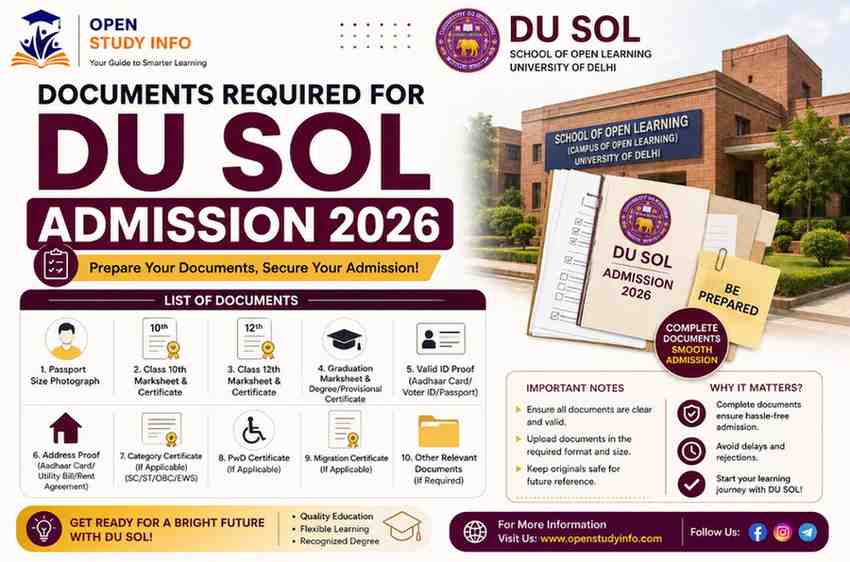
Getting the documents required for DU SOL admission 2026 ready before opening the application form can save you from upload errors, delayed verification and avoidable rejection. The correct checklist is not identical for every applicant: UG students, PG candidates, MBA applicants, non-CBSE students and reserved-category applicants have different requirements.
This OpenStudyInfo guide separates those lists clearly and explains file formats, self-attestation, verification and the steps that follow submission. It is based on the official DU SOL/CDOE prospectuses for the 2026–27 academic session.
UG applicants generally need: a recent photograph, signature, self-attested Class 10 documents and self-attested Class 12 documents. Applicants from a board other than CBSE must upload both certificates and marksheets as specified in the prospectus.
PG applicants additionally need: undergraduate marksheets, a degree or provisional certificate and, when applicable, a migration certificate, category certificate, income certificate or disability certificate.
MBA applicants need: photograph, signature, Class 10 and 12 marksheets, graduation marksheet and any experience certificate or employer NOC used to support their application.
The official DU SOL website currently shows UG and PG admissions for 2026–27 as live. The UG prospectus says the final admission date will be governed by DU/DEB and that changes will be announced on the official website. Do not depend on an old blog date or forwarded message; check the portal before applying.
Use OpenStudyInfo’s free Admission Document Checklist to mark documents as ready, identify missing certificates and track your preparation before filling out the DU SOL admission form. You can also save the official last date in the Student Deadline Tracker.
Documents Required for DU SOL UG Admission 2026
The UG document list depends partly on the board from which you passed Class 12. Every scan should be clear and every educational copy should be self-attested where the prospectus requires it.
CBSE applicants
- Recent photograph and signature
- Self-attested Class 10 marksheet
- Self-attested Class 12 marksheet
Applicants from other boards
- Recent photograph and signature
- Self-attested Class 10 certificate and marksheet
- Self-attested Class 12 certificate and marksheet
- Both compartment and passed marksheets, if applicable
Sign the photocopy or scanned copy yourself and add the date if requested. The signature should not cover your name, roll number, marks or certificate number. Upload the complete document with all corners visible.
UG applicants with a three-year engineering diploma
The 2026–27 UG prospectus separately lists documents for applicants holding a three-year engineering diploma under the relevant eligibility provision. Such applicants should keep these files ready:
- Recent photograph and signature
- Self-attested Class 10 certificate and marksheet
- Self-attested marksheets for semesters V and VI of the diploma
- Self-attested provisional certificate
Document eligibility does not automatically establish course eligibility. Check the programme-specific criteria in the current prospectus before paying the fee.
Documents Required for DU SOL PG Admission 2026
PG applicants need proof of both their school education and undergraduate qualification. The official PG prospectus lists the following documents for online submission, as applicable:
| Document | Who needs it? | Important check |
|---|---|---|
| Recent passport-size photograph | All PG applicants | Use a clear, recent photograph |
| Class 10 certificate/marksheet | All PG applicants | Upload a readable self-attested copy |
| Class 12 certificate/marksheet | All PG applicants | Name and date details must be clear |
| All UG annual/semester marksheets | All PG applicants | Include every required year or semester |
| UG degree or provisional certificate | All PG applicants | Use the provisional certificate if the degree is unavailable |
| Migration certificate | Graduates of a university other than DU | DU graduates normally follow the DU-specific instruction |
| Category or disability certificate | Applicants claiming reservation | Certificate must be in the candidate’s own name |
| Income certificate/BPL ration card | Eligible fee-concession or assistance applicants | Use the latest applicable certificate |
The 2026–27 PG prospectus allows registration with a CUET (PG) 2026 score as well as without one on the basis of graduation marks. Merit lists give priority according to the published admission method, so follow the portal instructions for your chosen route and keep its supporting result details ready.
Documents Required for DU SOL MBA Admission 2026
MBA applicants should keep the standard academic records ready along with supporting employment documents when they want work-experience weightage or apply under an experience-based category.
Core MBA documents
- Recent passport-size photograph and signature
- Self-attested Class 10 marksheet
- Self-attested Class 12 marksheet
- Self-attested graduation marksheet
Employment documents, if applicable
- Experience certificate from the employer
- No Objection Certificate from the current employer
- Other documentary evidence required for the claimed category
The official MBA prospectus says candidates without professional work experience can be eligible, but their merit is considered using graduation marks without experience weightage. Applicants claiming work-experience marks must provide valid supporting evidence.
Reserved Category and Fee-Concession Documents
Applicants claiming a benefit must upload the supporting certificate in addition to their normal academic documents. A category selection in the form is not enough by itself.
- SC/ST: a certificate issued in the candidate’s own name by a competent authority.
- OBC-NCL: a valid certificate showing non-creamy-layer status and a caste included in the applicable Central List.
- EWS: the applicable current-session certificate issued by a competent authority.
- PwBD: a disability certificate issued by the competent hospital or board.
- Fee concession: the latest original income certificate, where applicable.
- Financial assistance/BPL: self-attested BPL ration card and original income certificate, where required.
The official 2026–27 UG prospectus says OBC-NCL and EWS certificates should be made after 31 March 2026. Read the latest portal instruction for your category before uploading because certificate format and validity conditions may be updated.
DU SOL Document File Size and Format
For the main UG document list, the official prospectus specifies the following upload range. The live portal remains the final authority if a field displays a different limit.
| File | Official format | Size range |
|---|---|---|
| Photograph and signature | JPEG | 10 KB to 200 KB |
| Class 10 documents | PDF or JPEG | 10 KB to 200 KB |
| Class 12 documents | PDF or JPEG | 10 KB to 200 KB |
| PG academic/category documents | PDF or JPEG where specified | Generally 10 KB to 200 KB in the prospectus list |
Create separate files with simple names such as Class-10-Marksheet.pdf, Class-12-Certificate.pdf and OBC-NCL-2026.pdf. Open every file once before uploading to confirm that it is readable, upright and not password-protected.
How to Upload Documents for DU SOL Admission
Use the UG or PG admission link shown on the official DU SOL website. Avoid payment links received from unofficial messages.
Enter names, marks, board or university details exactly as they appear on your certificates.
Select the correct file, wait for the upload confirmation and preview it if the portal offers that option.
Recheck programme choice, category, marks, contact information and every uploaded scan. Do not submit with a blank or blurred page.
The UG prospectus says document verification may take a minimum of three to five days. The payment link becomes available after verification.
After successful payment, save the application, fee receipt and identity card. Keep both phone and cloud copies for future reference.
Common Document Upload Mistakes
- Blurry scans: small text, marks and certificate numbers should remain readable after upload.
- Name mismatch: spelling differences across marksheets, category certificates and the form can delay verification.
- Wrong document in the wrong field: do not upload a Class 12 certificate under the Class 10 field or combine unrelated records unless the portal instructs you to do so.
- Expired or invalid category proof: verify the issuing authority, session and non-creamy-layer/EWS requirement.
- Missing semesters: PG applicants should not omit an undergraduate year or semester from the required set.
- False or altered records: admission remains provisional until verification, and invalid documents can lead to cancellation and further action.
- Unverified payment page: pay only through the official admission portal and save the transaction record.
What Happens After Document Submission?
Uploading files does not always mean admission is confirmed. DU SOL verifies the submitted documents first. For UG admission, the official prospectus says verification is rigorous and may take a minimum of three to five days. After approval, the payment link is enabled; successful payment then allows the student to download the fee receipt and identity card.
Admissions remain provisional until the required records are verified. Keep checking your dashboard and registered email instead of assuming that silence means approval. If the portal asks for a corrected document, upload it within the permitted period and retain screenshots or acknowledgement of the update.
Frequently Asked Questions
What documents are required for DU SOL UG admission 2026?
UG applicants generally need a recent photograph, signature, self-attested Class 10 documents and self-attested Class 12 documents. Applicants from boards other than CBSE may need both the certificate and marksheet, along with both compartment and passed marksheets where applicable.
What is the file size for DU SOL admission documents?
The 2026–27 prospectus commonly specifies a range of 10 KB to 200 KB. Photograph and signature files are listed in JPEG format, while academic documents are generally accepted in PDF or JPEG format as specified. Follow the limit displayed in the live upload field.
Is a migration certificate compulsory for DU SOL admission?
It is not listed as a standard UG document for every applicant. For PG admission, a migration certificate applies to candidates graduating from a university other than the University of Delhi, subject to the current prospectus instructions.
Is work experience compulsory for DU SOL MBA admission?
No. The official MBA prospectus says applicants without professional work experience can be eligible. Work experience affects merit weightage or particular preference categories and must be supported by valid documents when claimed.
Can I edit a document after submitting the form?
This depends on the correction facility and status available on the admission portal. Check the dashboard immediately and use the official grievance or support route if the form no longer offers an edit option.
How long does DU SOL document verification take?
The UG prospectus says verification may take a minimum of three to five days because each uploaded document is checked. Actual time can vary with application volume and document corrections.
Do I need to send physical documents during online admission?
The initial admission process is online and requires scanned documents. However, admission remains provisional until verification, so keep every original safely available if DU SOL later asks to inspect it.
Final Checklist
Prepare only the documents that apply to your programme and category, keep each scan clear and within the portal limit, and match every name and academic detail before submitting. Most importantly, use the official 2026–27 prospectus and admission dashboard as the final authority. OpenStudyInfo will continue updating this guide when DU SOL publishes a material change.