
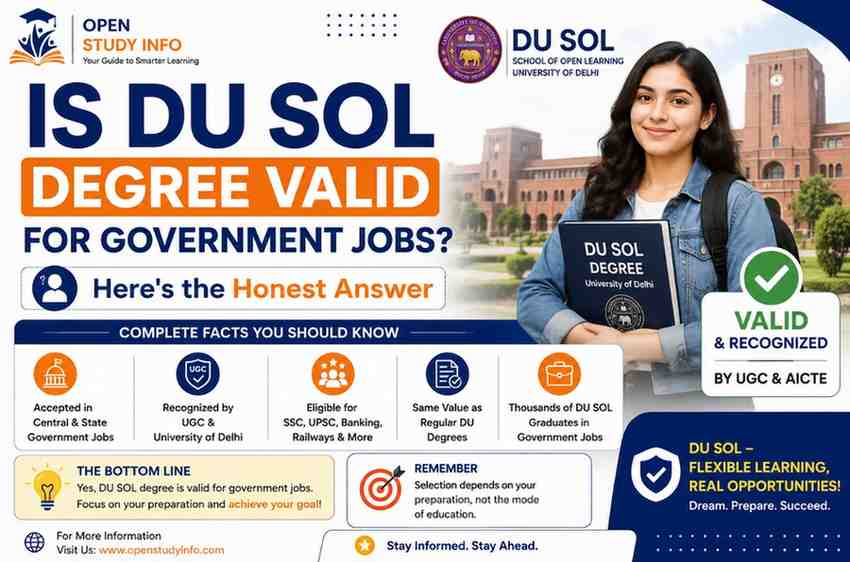
Is a DU SOL Degree Valid for Government Jobs?
Yes—an eligible degree awarded through DU SOL is generally valid for government-job applications when the programme and admission session are recognised. Your final eligibility still depends on the exact recruitment notification.
Quick answer
A DU SOL degree is conferred by the University of Delhi and can be used for government recruitment, higher studies and other opportunities requiring a recognised degree. Before applying, confirm that your programme/session was recognised and that you meet the post-specific subject, marks, age and professional-qualification rules.
Students often ask whether studying through the School of Open Learning will create a problem during a government-job application or document verification. The doubt is understandable, but the mode of study is not the only test. Recruitment authorities normally look at the awarding university, recognition status, completion date and the qualification written in that particular notification.
Why a DU SOL Degree Is Recognised
DU SOL—now presented by the university under its Department of Distance and Continuing Education/Faculty of Open Learning structure—is part of the University of Delhi. The university’s official prospectus states that the University of Delhi governs the admission criteria and examinations and confers degrees on SOL students.
UGC’s Open and Distance Learning regulations also state that recognised undergraduate and postgraduate degrees earned through ODL or online mode are treated as equivalent to the corresponding awards offered through conventional mode. The key word is recognised: the university and the relevant programme/session should fall within the applicable UGC–DEB recognition framework.
Which Government Jobs Accept a DU SOL Degree?
For posts that require a degree from a recognised university, a qualifying DU SOL degree can satisfy the education requirement. Check the current exam notice for all other conditions.
Graduate-level posts generally require a recognised bachelor’s degree. Post-specific subject, age, skill-test or percentage conditions may still apply.
IBPS, SBI and other bank notices usually ask for graduation from a recognised university. Read the relevant year’s notification before applying.
A DU SOL degree can be used for eligible graduate-level RRB posts, subject to the qualification and other criteria listed for the chosen post.
State PSCs and departments commonly accept recognised degrees, but domicile, language, subject and local eligibility rules can differ.
The degree may meet the basic graduation or postgraduate requirement, but TGT/PGT/NET roles can require specific subjects, marks, B.Ed or other credentials.
Cases Where Extra Checking Is Necessary
Most problems during recruitment are caused by a mismatch with the post—not simply because the candidate studied through SOL. Pay special attention in the following cases:
- Professional or regulated posts: engineering, medicine, nursing, law, architecture and other regulated fields can have mode-specific restrictions or statutory-council requirements.
- Teaching recruitment: a notification may require particular subjects across graduation years, a minimum percentage and B.Ed/teacher-eligibility qualifications.
- Technical or specialist posts: the employer may demand a named degree, diploma, licence, experience or specific coursework.
- Recognition period: confirm the status of your programme for the academic session in which you took admission.
- Incomplete degree: candidates with an Essential Repeat, pending paper or incomplete result are not degree holders until all programme requirements are cleared.
DU SOL Degree Validity at a Glance
| Purpose | General position | What you must check |
|---|---|---|
| UPSC/SSC/RRB | Recognised degrees are generally accepted | Current notification, age, subject and post-specific criteria |
| Bank recruitment | Generally accepted for graduation-based posts | Cut-off date, marks and computer/language requirements |
| State PSC/jobs | Generally accepted | State-specific eligibility, domicile and subject conditions |
| Teaching jobs | Degree validity is usually not the main issue | Subject combination, B.Ed, CTET/TET and minimum marks |
| Higher studies | Eligible for recognised PG admissions | Entrance test, programme prerequisites and university rules |
| Professional posts | Cannot be assumed automatically | Relevant council/regulator and permitted mode of study |
Documents to Keep Ready for Verification
Keep clear originals and readable copies ready before the document-verification stage:
- Final University of Delhi degree certificate
- All semester or annual marksheets
- Provisional degree, if the final degree is pending
- Government photo ID and application proof
- Programme/session recognition record, if specifically requested
- Category, experience or subject-specific certificates required by the post
If the recruitment board asks for recognition proof, use the relevant UGC–DEB record and the official DU SOL prospectus or confirmation for your admission session. Do not submit screenshots from unofficial websites as recognition evidence.
How to Verify Your DU SOL Programme
- Note your exact programme name and the academic session in which you were admitted.
- Check the official DU SOL prospectus or programme page for that session.
- Use the UGC–DEB website to check recognition information and equivalence guidance.
- Read the latest recruitment notification for the job you are targeting.
- If anything remains unclear, ask the recruiting authority in writing before the application deadline.
DU SOL vs Regular DU College for Job Eligibility
For a job that only asks for a recognised bachelor’s or master’s degree, the relevant legal question is recognition—not whether you attended daily classes. A regular DU college may offer more campus exposure, placements and in-person networking, while DU SOL offers flexibility. Those practical differences can affect your experience, but they do not by themselves make a recognised SOL degree invalid.
For a detailed comparison of study mode, fees and college experience, read our DU SOL vs regular DU college guide.
Frequently Asked Questions
Is a DU SOL degree valid for government jobs?
Yes. A qualifying degree conferred by the University of Delhi through a recognised DU SOL programme can be used for government-job applications. You must also meet the requirements in the specific recruitment notification.
Can I apply for UPSC with a DU SOL degree?
A DU SOL graduate can apply for UPSC examinations that require a degree from a recognised university, provided all other conditions in the current UPSC notification are met.
Is a DU SOL degree valid for SSC CGL and bank jobs?
It is generally valid for SSC CGL and graduation-based bank recruitment because the degree is awarded by the University of Delhi. Always check the latest notice for the cut-off date and post-specific criteria.
Is a DU SOL degree equal to a regular degree?
UGC regulations treat recognised undergraduate and postgraduate ODL degrees as equivalent to corresponding conventional-mode awards. Campus experience and delivery mode can differ, while recognition depends on the programme and session.
Can I do a regular master’s degree after DU SOL?
Yes, a recognised DU SOL bachelor’s degree can be used for postgraduate admission. The receiving university may require an entrance exam, minimum marks or particular subjects.
Is DU SOL valid for teaching jobs?
The degree can be valid, but teaching posts often require a specified subject combination, minimum marks, B.Ed and CTET/TET or another eligibility test. Check the exact recruitment rules.
How can I prove DU SOL recognition during verification?
Keep your degree and marksheets ready. If recognition proof is requested, use the official DU SOL prospectus or confirmation for your admission session and the relevant UGC–DEB recognition/equivalence information.