
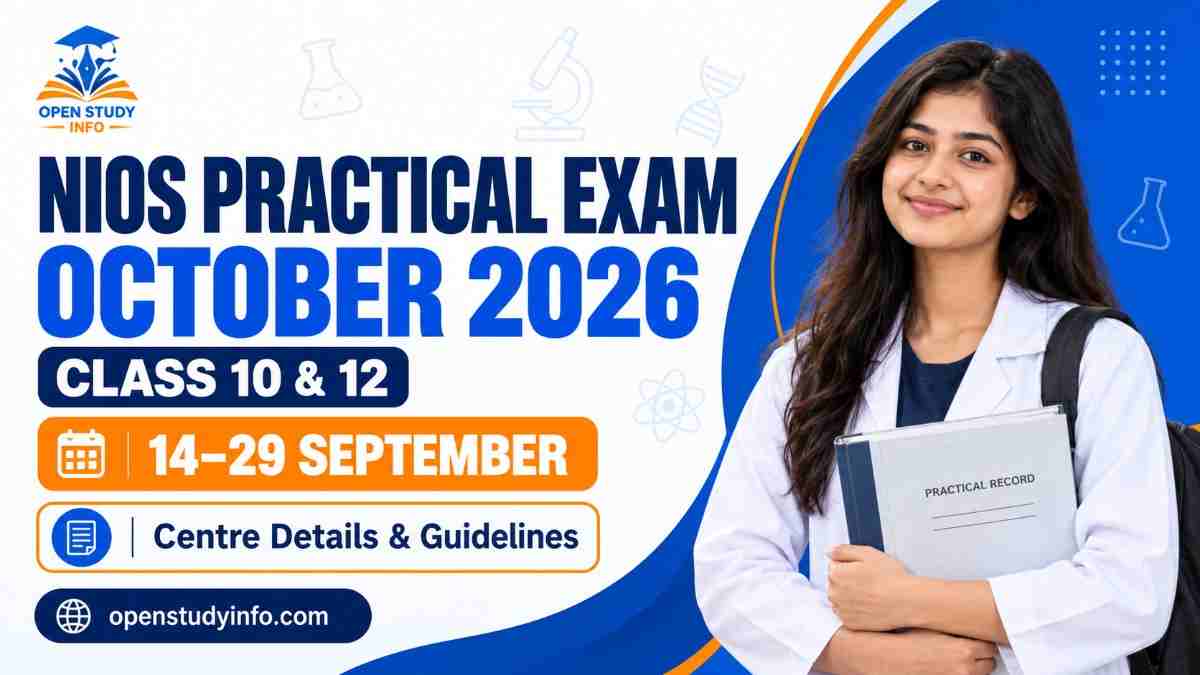
Practical dates confirmed: 14–29 September 2026
For the October 2026 public-exam session. Find your subject group, then confirm your exact batch, reporting time and venue with the allotted practical centre.
Checked: 7 September 2026If you are preparing for the NIOS practical exam October 2026, the first thing to do is check your subject code against the official schedule. NIOS has announced the practical examination period, so students no longer need to plan around an estimated “second half of September” window.
There are two details to keep separate: the date range NIOS gives your subject group, and the particular day and time your centre assigns to your batch. A friend taking the same subject elsewhere may have a different appointment within that range. This OpenStudyInfo guide explains how to confirm yours, prepare your file and avoid confusion about passing or reappearing.
NIOS Practical Exam Dates 2026: How the Schedule Works
The practical session begins on 14 September. NIOS places subjects into date ranges; the centre then arranges learners in batches according to facilities and the examination arrangements. You should attend on your allotted batch date, rather than arriving on any day within the overall 14–29 September period.
The tables below cover common academic subjects from the attached date sheet. Match the numeric subject code with your registration record. If you have an additional or vocational subject, consult the full official PDF for its group.
Class 10 / Secondary practical subject groups
| Official date range | Subjects and codes |
|---|---|
| 14–17 September 2026 | Science and Technology (212), Home Science (216), Carnatic Sangeet (243), Folk Art (244), Physical Education (273) |
| 18–21 September 2026 | Painting (225), Mathematics (211), Hindustani Music (242), Data Entry Operations (229), Natyakala (285) |
Class 12 / Senior Secondary practical subject groups
| Official date range | Subjects and codes |
|---|---|
| 14–17 September 2026 | Home Science (321), Biology (314), Geography (316), Painting (332), Computer Science (330), Mass Communication (335), Early Childhood Care and Education (376), Entrepreneurship (349) |
| 18–21 September 2026 | Chemistry (313), Physics (312), Environmental Science (333), Physical Education (373), Data Entry Operations (336), Library and Information Science (339), Natyakala (385), Krishi: Production, Processing and Marketing (383) |
Source: attached date sheet in the October 2026 practical-examination notification on NIOS SDMIS. These are subject-group ranges, not individual reporting appointments.
How to Confirm Your Practical Centre, Date and Time
Your practical venue may differ from your theory examination centre. The official date-sheet notes say practicals are held at study centres unless the concerned Regional Centre notifies a different arrangement. This can apply where an AI is cancelled or non-functional, or another arrangement is needed.
Start with the centre connected to your NIOS record, then check the latest practical hall ticket and official centre instructions. Do not rely on last session’s venue or a classmate’s address.
- Keep your details ready: enrolment number, course level and the subject codes for which you will appear.
- Ask for the subject-wise batch list: confirm the date, reporting time, examination time and full address.
- Ask about materials: clarify which file, stationery, clothing or permitted equipment your subject requires.
- Keep a written record: save the official message or photograph the centre notice. Note whom you contacted and when.
If the hall ticket and centre message appear to disagree, ask the coordinator to resolve the mismatch and involve the Regional Centre when necessary. A centre confirmation should implement the official schedule, not replace it with an unrelated date.
NIOS Practical Hall Ticket: Download and Checks
The notification says practical hall tickets will be made available on the NIOS portal before practical examinations begin. It does not give a fixed release day. The presence of a download form alone does not establish that every learner’s October document is available.
Open the official hall ticket portal, enter your 12-digit enrolment number and select the applicable practical hall-ticket type when available. Check the session, photograph, subject codes and centre information before saving and printing it.
Download the applicable practical and theory documents separately. For the detailed steps, use our NIOS October 2026 hall ticket guide; follow the current practical schedule above when planning your visit.
If your hall ticket does not generate, recheck the number and examination type. NIOS also states that the examination fee must have been paid and your photograph must be available in its records. Contact the Regional Centre promptly if the problem remains, keeping your fee receipt ready.
Practical File, Exam Tasks and Viva: What to Prepare
A practical examination checks what you can do with the subject. Depending on the course, that may involve an experiment, a computer task, an activity, a performance or another assessed exercise. The record book and oral questions may form part of the subject’s assessment scheme.
There is no single file format or viva-mark allocation that should be applied to every NIOS subject. Use your current practical manual and centre instructions. Avoid assuming that every viva carries 8–12 marks, or that every practical is evaluated entirely by an external examiner.
Prepare a file you can explain
- Check the required activities against the correct subject code and practical manual.
- Organise your own work with a clear index, headings, observations, diagrams and conclusions where relevant.
- Check your name, enrolment number and subject code on the cover and other required pages.
- Ask whether your record needs checking or signatures before exam day, and arrange this in time.
- Keep a personal copy of your work before submission, without photographing restricted examination material.
Practise the task and explain the result
For a science activity, work through the aim, procedure, observations and precautions. For a computer subject, practise the required tasks on a computer instead of only reading about them. For activity-based subjects, rehearse the process or demonstration your manual requires.
A useful viva practice method is to explain one activity aloud: what you did, why you chose that method and what the result means. If a step is unclear, ask your tutor before the examination. The official NIOS lab-practical resources can support revision alongside the prescribed manual.
What to Carry on Practical Exam Day
Follow the instructions on your hall ticket and the centre notice. As a preparation checklist, keep these items ready the previous evening:
- Your printed practical hall ticket and the identification required by NIOS.
- Your practical record/file and any other subject-specific work requested by the centre.
- Pens, pencils, an eraser, ruler and other permitted stationery.
- Any specifically required lab coat, art materials or other permitted items confirmed by the centre.
- The venue address and reporting time, saved where you can check them easily.
Plan your travel to reach before the stated reporting time. Check in as instructed, complete the attendance formalities and listen carefully to the examiner’s directions. Ask before using an unfamiliar instrument, and follow laboratory safety instructions throughout.
NIOS Practical Passing Marks: Class 10 vs Class 12
The distinction between Secondary and Senior Secondary matters when interpreting practical marks. Use the correct level’s rule, along with the applicable subject and aggregate requirements.
| Course level | Passing requirement |
|---|---|
| Class 10 / Secondary | At least 33% in the public-exam theory-plus-practical total, excluding TMA, and at least 33% in the aggregate including applicable TMA marks. |
| Class 12 / Senior Secondary | At least 33% separately in theory and practical wherever applicable, excluding TMA, and at least 33% in the aggregate including applicable TMA marks. |
A Class 12 student cannot use a high theory score to compensate for a below-pass practical component. Check the maximum marks in your own subject’s scheme; do not apply a calculation for one subject to another. For examples and the distinction between practical and TMA marks, read our NIOS Class 12 passing marks guide.
Reference: NIOS Academic Prospectus 2026–27, Table 8, printed page 73. This PDF is linked from the official SDMIS admission menu.
What Happens If You Miss or Fail Your Practical?
When preparing for your next attempt, keep the applicable practical instructions beside the theory material. Use the NIOS syllabus and course-material download guide to match the correct class, subject code and document.
If you cannot attend your allotted batch, inform the centre immediately and explain the situation. Keep any relevant supporting record. Ask what is permitted under the official schedule, but do not assume the centre can guarantee another sitting or extend the examination period.
The reappear rules depend on your level and recorded result:
- Secondary: the 2026–27 prospectus says theory/practical marks of unsuccessful learners are retained for credit accumulation and result calculation, with the better marks considered. Check your retained record and the required reappear components with NIOS before registering.
- Senior Secondary: part credit is available for a passed theory or practical component. If one component is passed and the other is unsuccessful, the passed component can be retained under the applicable rules.
For example, a Class 12 learner who passes theory but fails practical should check the retained theory credit before registering to reappear. This is different from an improvement attempt. Confirm the examination entry and fee requirements with NIOS; a retained component does not by itself determine the fee payable.
Reference: Section 4.3.2 of the NIOS Academic Prospectus 2026–27, printed pages 69–70. The separate improvement provisions are in Section 4.4; do not apply an older blanket “repeat both” rule to every learner.
Frequently Asked Questions
When are the NIOS practical exams for October 2026?
NIOS has scheduled the practical examinations from 14 to 29 September 2026. Your subject group has a specified date range, and your centre will confirm your individual batch date and time.
Is there an official NIOS practical date sheet?
Yes. A subject-group date sheet accompanies Notification 57/2026, dated 31 August 2026. Centres arrange the exact learner batches within the applicable schedule.
Will my practical and theory exam centres be the same?
They may differ. Check your practical hall ticket and the latest instructions from the allotted centre or Regional Centre instead of assuming your theory venue also applies to practicals.
Does NIOS Class 10 Mathematics have a practical?
Mathematics, subject code 211, appears in the October 2026 practical date sheet in the 18–21 September group. Confirm your batch date and applicable work requirements with your centre.
Does every NIOS practical viva carry 8–12 marks?
No single viva-mark range should be applied to every subject. The tasks, record work and oral assessment depend on the current subject-specific practical scheme.
What are the passing marks in NIOS practical subjects?
Secondary students need 33% in the public-exam theory-plus-practical total. Senior Secondary students need 33% separately in theory and practical wherever applicable. Both levels also require 33% in the aggregate including applicable TMA marks; TMA cannot replace the external-examination minimum.
If I pass Class 12 theory but fail practical, must I repeat both?
Not automatically. NIOS provides part credit for a passed Senior Secondary component. Confirm the retained theory credit, practical reappear entry and applicable fees against your result and current NIOS rules.
Can my centre guarantee another practical if I miss my batch?
No replacement sitting should be assumed. Inform the centre immediately and ask what the official arrangements permit. A personal emergency does not automatically create an extra examination date.
Your Next Step
The October-session practical schedule is confirmed. Find your subject group, contact your centre for the batch appointment, and finish the required work before that day. Keep your practical hall ticket and venue details together so that preparation and travel are both organised.
OpenStudyInfo brings the schedule and student guidance together; NIOS and your allotted centre remain the sources for examination arrangements and individual eligibility.