
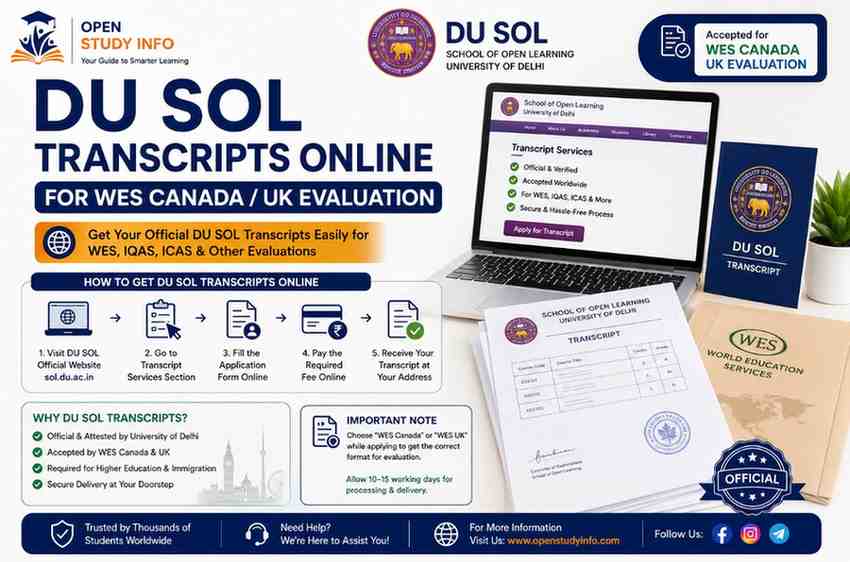
If you have a degree from the Delhi University School of Open Learning and are now applying for Canadian permanent residency through Express Entry, or having your degree assessed by Ecctis (previously UK NARIC) for a UK visa or employment, you have likely reached the same hurdle as many other DU SOL graduates. Your degree and marksheets will not be sufficient on their own. WES and Ecctis will require an official transcript, and the conditions that govern how that transcript is sent to them are more stringent and confusing than most applicants expect. This guide explains the entire process for DU SOL students — the application process, costs and required documents, as well as the one rule that catches most applicants off guard.
Quick Reference: DU SOL Transcript for WES/Ecctis
- Do not apply through SOL — the University of Delhi’s central transcript portal is the only way to apply
- A WES/Ecctis reference number is mandatory before you start the transcript application
- Cost: ₹1,000 (up to 6 years since your last exam) or ₹1,500 (beyond 6 years); US$100/US$150 if applying from abroad
- Normal processing time is 21 working days; Fast Track brings this down to about 10 working days for an additional ₹2,000
- You are not allowed to collect the transcript and send it to WES or Ecctis yourself — the University has to send it directly
Read More:Documents Required for DU SOL Admission 2026
Why a DU SOL Marksheet Alone Is Not Enough for WES and Ecctis
WES and Ecctis do not treat DU SOL marksheets and degree certificates as sufficient proof on their own. What they require is a university-issued transcript — a single document that carries your complete academic record, certified and sealed by the issuing institution, showing every paper from every semester, the grading scale used, and the credit distribution of the programme. This is what lets a Canadian immigration officer or a UK employer understand and translate your DU SOL programme into an equivalent they recognise.
A lot of DU SOL students don’t realise they need this separate document until their WES or Ecctis application is already stuck waiting on it. Starting the transcript request the same week you create your WES or Ecctis account is the easiest way to avoid this situation.
Step 1: Get Your WES or Ecctis Reference Number First
Before you touch the Delhi University transcript portal, register with whichever evaluating body you’re applying to. For Canadian Express Entry or most Canadian university/employer applications, that’s WES. For a UK visa, professional registration, or employment-related recognition, that’s usually Ecctis. Once you pay the application fee and set up your applicant profile with either body, they’ll issue you a reference number. This number is required on the DU SOL transcript application, and in some cases the University will ask for it to confirm the request is for evaluation purposes.
Step 2: Apply for the Transcript via the University of Delhi
A mistake a majority of DU SOL students make is assuming there’s a transcript request option inside the SOL student dashboard or the MEDHASETU portal. There isn’t. Transcripts for all DU-affiliated programmes, SOL included, are processed centrally by the University’s Examination Branch through a separate online system.
The request form sits under the Examination Branch’s Services section, and the actual application form is hosted on the University’s certificates portal. You’ll create an account there (separate from your SOL login), enter your programme and enrolment details exactly as they appear on your marksheets, and upload your supporting documents as a single combined PDF.
💡 Pro Tip
List every subject you studied in full, including electives, exactly as they appear in your syllabus. Applications get rejected as “incomplete” more often over abbreviated subject names than any other single reason. If you don’t have access to your official syllabus, you’re allowed to self-attest a typed list of paper codes, titles, and marks and upload it as a separate document.
Documents to Upload
All documents must be clear, self-attested, and combined into a single PDF, except for the syllabus, which is uploaded separately:
- All semester or year marksheets from your DU SOL programme
- Fee receipts for the transcript, and separately for Fast Track or postal charges if applicable
- Evidence of urgency, only if you’re applying under Fast Track
- Proof of postal address, if you want a physical copy delivered to that address
- A government-issued photo ID
- A recent passport-size photograph and your signature
- Syllabus details, or a self-attested list of paper codes, titles, marks, and credits for your programme
DU SOL Transcript Fee
| Category | Applying from India | Applying from Abroad |
| Transcript (up to 6 years since last exam) | ₹1,000 | US$100 |
| Transcript (more than 6 years since last exam) | ₹1,500 | US$150 |
| Additional copy (per copy, max 5) | ₹100 | US$10 |
| Fast Track processing | ₹2,000 | US$50 |
| Postage (per dispatch) | ₹500 (within India) | US$50 (outside India) |
The “years” bracket is calculated from the date of your last exam, not your admission date, so double-check which one you actually fall into before paying. The Fast Track fee is non-refundable, and it only genuinely speeds things up when sufficient evidence of urgency is attached — paying the extra fee alone does not guarantee priority handling.
The Most Critical Rule: You Cannot Send It Yourself
Understanding this rule is critical when dealing with WES or Ecctis, and it’s where most Indian applicants lose weeks. Since December 2018, WES has mandated that transcripts for Indian institutions must be sent by the university directly, either through a secure digital route or in a stamped, sealed envelope. A transcript collected by the applicant and mailed by the applicant will be rejected. Ecctis applies a similar rule for UK-bound evaluations.
Practically, this means you cannot choose a “postal delivery” option on the DU SOL transcript form and enter your own overseas address expecting WES to accept what arrives. The University must send it to WES or Ecctis directly — which means addressing the dispatch to WES or Ecctis on your application, or confirming with the Examination Branch whether digital dispatch is available for your specific evaluator.
⚠️ Common Mistake to Avoid
If your intended evaluation is with WES or Ecctis, don’t request the transcript to be posted to your own home or hostel address. Students who do this have to apply, pay, and wait all over again, since a self-forwarded document is not accepted. Enter the evaluating body’s mailing address directly on the transcript application, and clearly provide your WES or Ecctis reference number so the Examination Branch can match the dispatch to your file.
Digital Dispatch versus Sealed Postal Copies
WES runs a digital verification programme with a limited number of partner institutions, primarily in India, China, and the Philippines, where the institution uploads transcripts electronically and WES skips the postal mailing process entirely. Whether Delhi University or SOL specifically participates in this can change, so checking your WES or Ecctis dashboard, or asking the Examination Branch directly, is the right move before you assume your route will be digital. If it isn’t available, plan for the sealed-envelope postal route and factor in the additional transit time.
People also read:DU SOL BA vs Regular DU College
Normal Processing versus Fast Track: What to Actually Expect
Under normal processing, DU SOL transcripts are typically issued within 21 working days. Fast Track brings this down to about 10 working days, but the extra fee alone doesn’t guarantee that timeline — the Examination Branch reviews your supporting evidence before approving Fast Track treatment. If your Express Entry profile or a UK application deadline is approaching, attach whatever proof of that deadline you can, such as an ITA, an offer letter, or a visa appointment confirmation, to strengthen the case for Fast Track approval.
On top of the University’s own processing time, add however long WES or Ecctis themselves take to receive and evaluate the document once it arrives; WES typically needs several weeks after the documents land on their end. For Indian applicants overall, the full stretch from starting the transcript request to holding a finished WES report commonly runs eight to ten weeks, so timing your application well ahead of any immigration or admission deadline is essential to avoid your profile sitting stagnant while it loses points or validity.
What Happens If Your Application Is Incomplete
Once you submit online, you’ll receive an acknowledgement confirming provisional acceptance, but that’s not the same as approval. The Examination Branch separately validates every application for completeness, and anything missing — an unclear subject name, a mismatched enrolment number, or a missing fee receipt — gets rejected rather than sent back for correction. There is no revision step: an incomplete submission means starting over, paying again, and losing however many working days you already waited. Review every field against your original marksheets before you submit, not after.
Frequently Asked Questions
Can I have my DU SOL transcript mailed to my address abroad and then forward it to WES myself?
No. WES will not accept a transcript that wasn’t mailed directly by the university in a sealed envelope or sent through an approved digital channel. Always list the evaluating body’s address as the delivery destination on your transcript application, not your own.
Do I need a transcript for every year of my DU SOL programme, or just the final year?
WES and Ecctis require your complete academic record, so your transcript needs to cover your entire programme, not just the final semester or year. If you also hold an earlier qualification from a different institution, both WES and Ecctis typically expect a transcript from that institution as well.
How long before my WES or Ecctis deadline should I start the DU SOL transcript process?
Given 21 working days for normal processing, plus postal or digital transit time, plus WES or Ecctis’s own evaluation period, most DU SOL students should start at least two to three months before any hard deadline, longer if Fast Track approval isn’t likely.
What if the Examination Branch doesn’t support direct digital dispatch to my evaluator?
You’ll need to use the sealed postal route instead. Make sure the correct WES or Ecctis mailing address and your reference number are entered accurately on the application, and allow extra time for international courier transit.
Is the transcript fee different if I’m living outside India?
Yes. The fee for applicants completing the application from outside India is quoted in US dollars and is higher than the INR fee charged within India, so check which rate applies based on where you’re filling out the application from.
Can someone else submit the transcript application on my behalf?
No. It’s against University policy to have a transcript issued through any outside agency, and using such services can lead to action against your application. The online form must be completed and submitted by you.
Read also:DU SOL Degree Valid for Government Jobs?
Final Thoughts
The DU SOL transcript process for WES or Ecctis isn’t as complicated as it looks once you understand the two things that trip up most applicants: the request goes to the University’s central Examination Branch, not the SOL portal, and the document must travel from the University directly to your evaluator, never through you. Get your WES or Ecctis reference number sorted first, list your subjects exactly as your syllabus states them, and give yourself enough time before any deadline. For more DU SOL guides on admissions, documents, and portals, keep checking back on openstudyinfo.com.